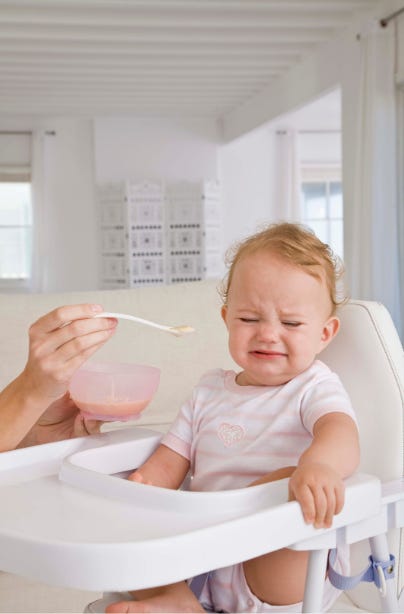
If your 8-month-old happily swallows smooth apple sauce or silky suji kheer, but immediately gags, spits, or vomits the moment a stray lump of rice appears, you are not alone.
Around the 8 to 10-month mark, thousands of parents hit what feeding specialists call the “Texture Boundary.”
It usually goes like this: You feel ready to transition toward family meals. You mash the dal-chawal slightly instead of blending it smooth. You offer a spoon with high hopes. Seconds later, your baby gags, spits up the food, and you decide it’s easier to stay on smooth purees for now.
Before you pull out the blender again, there is something crucial to understand:
Your baby isn’t being “picky,” and their stomach isn’t “too sensitive.” Their mouth is simply learning a physical skill they haven’t learned yet.
Here is the developmental science behind why lumps cause gagging, how mouth-mapping works, and a step-by-step roadmap to move from purees to family meals safely and smoothly.
Front-to-Back vs. Side-to-Side
To understand why chunky food triggers vomit, we have to look at how a baby’s tongue works.
- The Liquid/Puree Mechanism: From birth, babies suckle. They use a simple front-to-back tongue wave to push liquids or smooth purees directly to the back of the throat to swallow. It requires zero chewing or oral manipulation.
- The Textured Food Mechanism: Solid or lumpy food cannot be safely swallowed whole. To process a piece of cooked vegetable or mashed rice, the tongue must do something complex: move the food sideways (laterally) to the gums or molars, hold it there to be crushed, and then gather it into a ball (bolus) before swallowing.
When a baby who has only known smooth purees suddenly feels a soft lump, their brain defaults to the front-to-back suckle reflex.
Because the lump isn’t chewed first, it lands straight at the back of the tongue. The brain senses an unchewed bite near the airway and triggers gagging or vomiting in order to keep your baby safe.
Gagging isn’t a sign of failure; it is your baby’s internal safety system working perfectly while their oral-motor skills catch up.
What Is “Mouth-Mapping”?
Before a baby can chew texture, their brain needs a detailed internal map of their own mouth:
- Where are my gums?
- How far back can food go before I gag?
- How hard do I need to push my tongue to move something to the right side?
If a baby stays on ultra-smooth, blended purees past 9 or 10 months, their mouth-map stays underdeveloped. The sensitive gag trigger stays located near the middle/front of the tongue instead of naturally moving further back as they explore textures.
The goal isn’t to force lumps, but to give their mouth the sensory input it needs to update its internal map.
The 4-Stage Texture Bridge (Puree to Dal-Chawal)
Instead of jumping straight from blended soup to chunky rice, use this gradual, sensory-friendly texture ladder over 2–3 weeks:
Stage 1: Smooth Puree ➔ Stage 2: Thick & Viscous ➔ Stage 3: Minced/Fork-Mashed ➔ Stage 4: Soft Table Staples
1. Smooth Puree
- Textural feel: Completely uniform, runs off a spoon easily.
- Examples: Blended bottle-gourd (lauki), smooth strained dal, apple puree.
2. Thick & Viscous
- Textural feel: Thick enough to stay on an upturned spoon, but completely smooth without sudden lumps. This forces the tongue to work harder without triggering the lump-gag.
- Examples: Thick suji halwa made with ghee, thick mashed avocado, Greek yogurt/hung curd, heavy dal reduction.
3. Uniform Minced & Fork-Mashed
- Textural feel: Soft, small, uniform textures suspended in a thick base. Crucial rule: Avoid thin liquids with hard floaters (like watery dal with whole rice grains), as this confuses the swallow reflex.
- Examples: Well-mashed yellow moong dal khichdi with extra ghee, fork-mashed sweet potato, finely flaked paneer stirred into thick curd.
4. Soft Family Table Staples
- Textural feel: Soft pieces that easily squish between your thumb and index finger.
- Examples: Well-cooked dal-chawal lightly pressed with a fork, soft steam-cooked carrot sticks, tiny bites of soft paratha dipped in dal.
Simple Recipes to Bridge the Texture Gap
Ghee & Moong Mash
Pressure-cook ¼ cup yellow moong dal and 2 tbsp rice with turmeric in 1.5 cups water until ultra-soft. Temper cumin seeds in 1 tsp ghee, and mash the fragrant ghee and cooked mixture thoroughly with a fork into a thick, uniform paste.
Soft Paneer & Curd Mash (Stage 3)
Whisk ½ cup of thick full-fat curd with a pinch of roasted cumin powder until smooth. Fold in ¼ cup of finely grated fresh paneer so the creamy curd coats the soft crumbs, creating a smooth, non-dry texture that is easy to swallow.
Tips for Stress-Free Meals
- Check Foot Support: A baby sitting in a high chair with dangling feet spends all their energy trying to balance their body, leaving less energy for complex tongue movements. Ensure their feet rest flat on a footrest (or a DIY strapped box) to ground their posture.
- Never Rush or Surprise: Let your baby touch the food with their hands before it enters their mouth. Hand-to-mouth exploration tells their brain exactly what texture to expect before the spoon arrives.
- Model the Chew: Sit across from your baby and chew exaggeratedly with open mouth movements (Mmm, chew chew chew!). Babies learn lateral tongue movements by watching you chew.
- Stay Calm During Gags: If your baby gags, lean forward slightly, stay calm, and say in a reassuring voice: “You’re working that out!” If you panic or scream, your baby will associate textured food with danger.
The Takeaway
Chewing textured food is a learned developmental skill. Just like sitting up, crawling, or taking first steps. Expect a few gags, messy faces, and slow meals along the way. By honoring your baby’s oral-motor progression and building texture gradually, you’ll set them up for a lifetime of happy, confident family dining.
What texture is your baby currently struggling with the most, or what’s holding you back from introducing chunky family foods? Drop your thoughts or questions in the comments below. I read and reply to every single one!
Want to Take the Guesswork Out of Feeding?
Learn how to introduce solids safely, manage gagging vs. choking with confidence, and help your baby enjoy family meals right from the start.
Check out our complete archive of expert parent guides here: BLW India Post Archive